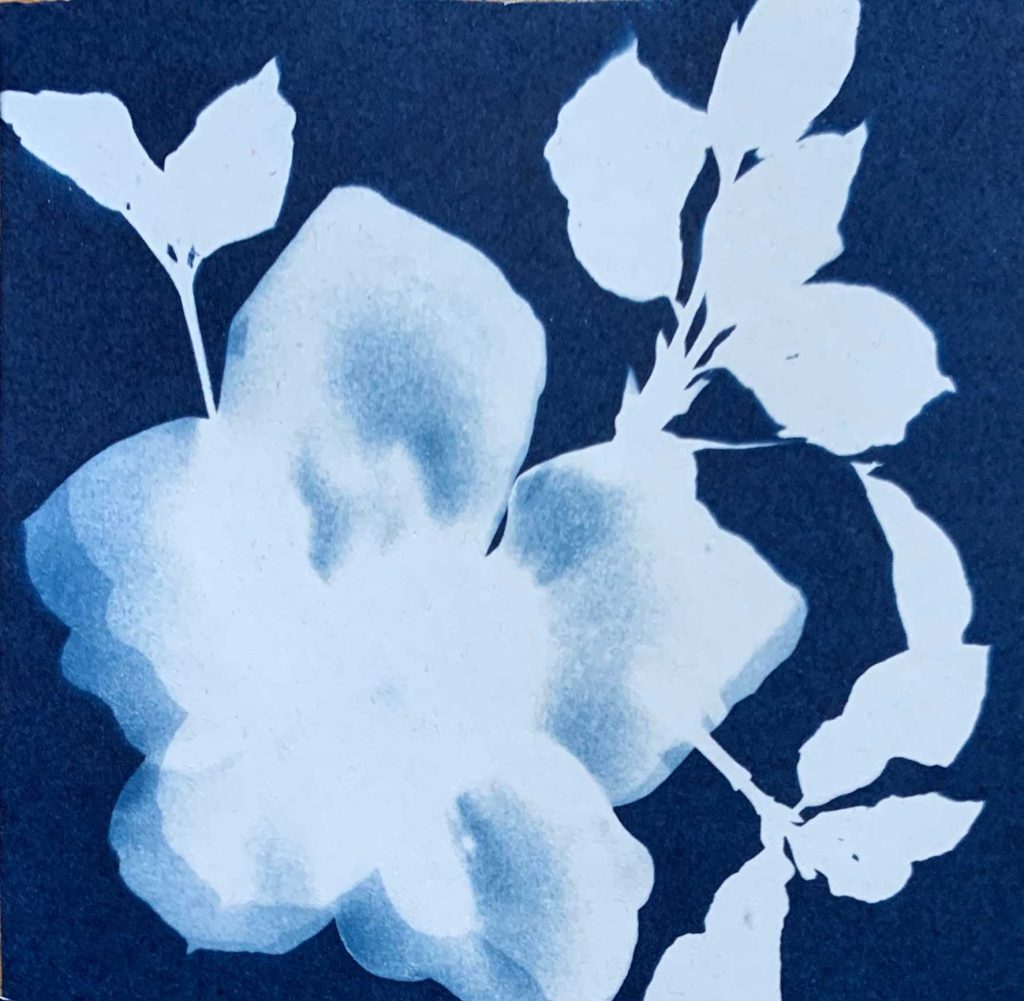
I’m so thrilled! For our January gathering, we will have a special opportunity to create cyanotype prints with Carl! These beautiful photograms or “sun prints” can be created by laying materials on treated paper and exposing it to UV light. Places where the paper is shaded from the light source will remain white, while the rest of the paper turns a deep Prussian blue. If you want to get a head start learning what’s involved in cyanotype printing, so that you can prepare and bring the best materials, and make the most of your time, check out this pdf of a good basic cyanotype guide.
January Gathering Details
Date: Wednesday, January 7, 2026
Time: 5:30 – 7:30 pm
Location: The Ansel Adams Gallery Workshop Room (Here’s a page with directions in case you haven’t been to this part of the gallery before.)
What to Bring:
- Materials to print. Classically, this would be something like flowers (perhaps pressed flowers in this season), grasses, or leaves that we can lay on top of the treated paper when we expose it to light. Items like ferns, with complex edges, are particularly beautiful. Plus, you can also try printing over stencils/papercuts or lace. If you have any negatives lying around, you can print these as well! Or if you have access to acrylic plates or transparencies, you could also draw or write on these and then print the negatives here as well. To get your creative juices flowing, this article has a bunch of different ideas for playing with cyanotype prints. Nature journaler, Kristin Link, also has some ideas for using cyanotype photograms in a nature journal. And again, here is that basic cyanotype pdf to get you started.
- Paper or other natural materials to print on. Carl has generously offered to pre-treat some paper for us ahead of time so that we can begin composing our sunprints right away. However, we will also have a chance to treat our own paper or other surfaces. Bring some extra watercolor paper (something that can be submerged in water), cotton fabrics, or even wood can be treated and provide a base for a cyanotype print.
- Cardboard, clipboard, or other firm surface to support your compositions as we move them in and out of the UV box.
- Apron/gloves/synthetic clothes, or clothes that can be stained. The process was actually a lot less messy than I expected, but I’d hate to see you walk away with bright blue spatters on your favorite white linen shirt. Note that the Prussian blue color only adheres to natural fabrics, so if you’re wearing a nylon shirt/pants, it should wash right off your clothes.
- Ziplock bag? Once we are done exposing our prints to UV light, we will be washing out the reagents, so your paper will be wet. Mine dried out surprisingly quickly, but if you are worried about moisture, you may want to bring a plastic bag or something to put your prints in while you get them home.
- Additional journaling/notetaking supplies – Notetaking materials so often come in handy. You may want to document what you noticed, note questions, and connections you made, or take notes on the cyanotype printing process itself. Once we have washed the reagents away, you could also consider filling in the white space with additional details.
- A headlamp or other light – Since we have access to indoor space, lights would mostly be for navigating to and from the gallery in the dark, but if you wish to explore the evening outdoors as well, an extra light could be handy.
- Your Curiosity and Wonder. The last thing on the list, but the most important.
Activities:
Taking advantage of this opportunity to create cyanotype prints will certainly be the highlight of the evening. Depending on how many of us there are, we may be able to move quickly between composing, exposing, and developing our prints. However, I will also have a few other materials for ways to include pictures in our nature journals without drawing or painting, in case we end up needing to wait.
One of the advantages of sitting down to draw or paint something in our journals is the extra time that we spend observing our subject. I wonder how that might change when we create pictures through cyanotype printing, rubbings, or other picture-generating methods. Are there ways that these processes change the way we ‘see’ or notice our subjects?
A note on parking:
Although public parking is available nearby at the Village Store/Camp 6 lot, since we are arriving after hours, we can also use the employee lot just behind the gallery and enter through the camouflaged back entrance. I will include a picture of the back door at the bottom of the directions to the workshop space, too. It can be hard to spot even during the daylight if you don’t know what you’re looking for.